

A high yielding crop requires a large amount of nitrogen (N), and legumes have some of the highest N requirements in row crops. For example, a 35 bu/ac soybean crop will take up 160-200 lbs/ac of N from the soil and a 50 bu/ac pea crop will take up 138-168 lbs/ac of N (1). This is a tall order for any crop, but legumes evolved a clever way of getting the N they need; not from the soil, but from the air. In this week’s edition of Growing Possibilities, we will be looking at how rhizobial inoculants work and how root nodules with N-fixing bacteria are an essential part of your legume crops.
First and foremost: What are the root nodules?
Root nodules are round growths of tissue that form on the roots of legume plants and represent a symbiotic relationship between soil bacteria and legume plants. Nodules form when a specific bacterium infects a developing root and begins replicating inside it. This infection is welcomed by the host plant, as it has evolved a special relationship with these bacteria. The process of root nodule formation really begins with the application of a rhizobial inoculant to your crop, such as XiteBio® SoyRhizo® for Soybean crops or XiteBio® PulseRhizo® for Pea, Lentil, and Faba bean crops. The rhizobia from your inoculant application will detect chemical messengers that are released by a plant to attract compatible bacteria. The rhizobia then release their own chemical messengers called Nod factors that interact with a nearby root hair on the host plant. After a rhizobium comes in contact with the tip of the root hair, the root hair curls around it and they form what is called an “infection thread”, which is a pathway where bacteria can travel down the root hair. Once the rhizobium reaches the epidermal tissue of a root it begins to proliferate and a root nodule begins to form (2).
Once a nodule is formed, the bacteria will begin performing N-fixation, meaning they take nitrogen from the air (N2) and convert it into a form the host plant can use for its N nutrition (most commonly ammonia). In return, the rhizobia get energy (C) and nutrients from the host plant and a safe place to grow. This relationship is highly specific, with a specific species of bacteria forming this relationship with a specific species of host plant. In soybeans, for example, this bacterium is Bradyrhizobium japonicum, with other legumes forming nodules with different bacterial species.
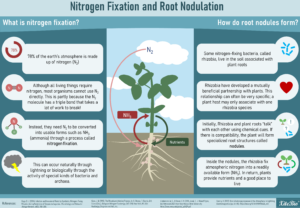
The amount of N a legume crop gets through this symbiotic relationship all depends on the bacteria that colonize it. A large population of fresh, vigorous rhizobia that have been chosen for their optimal N-fixing ability and their ability to nodulate will give you the best results possible. A well nodulated legume crop can receive a substantial amount of its N requirements solely through N-fixation. Soybeans can get up to 60% of their required N through N-fixation, while Peas, Lentils and Faba beans can get up to 80% (3). To ensure an optimal population of rhizobia exist in your soil, it is usually recommended to inoculate your legume crop every year at seeding.
A well nodulated legume crop has a multitude of benefits, and not just on this year’s crop. Legume crops leave a portion of the N they fix in the soil when they are harvested, enriching your field’s succeeding crop with an N boost right from the start. XiteBio’s premium liquid inoculants (XiteBio® SoyRhizo® for Soybean and XiteBio® PulseRhizo® for Peas, Lentils & Faba beans) are formulated with our unique rhizobia to provide optimal nodulation and the highest N-fixation your plant can achieve. Visit xitebio.ca to learn how our inoculants can help your pulse or soybean crops reach their greatest potential this season.
References:
1) https://saskpulse.com/files/general/160401_Nitrogen_management_for_pulses2.pdf
2) Wang Q, Liu J and Zhu H (2018) Genetic and Molecular Mechanisms Underlying Symbiotic Specificity in Legume-Rhizobium Interactions. Front. Plant Sci. 9:313. doi: 10.3389/fpls.2018.00313
3) https://saskpulse.com/growing-pulses/
4) Costa MP, Reckling M, Chadwick D, Rees RM, Saget S, Williams M and Styles D (2021) Legume-Modified Rotations Deliver Nutrition With Lower Environmental Impact. Front. Sustain. Food Syst. 5:656005. doi: 10.3389/fsufs.2021.656005