

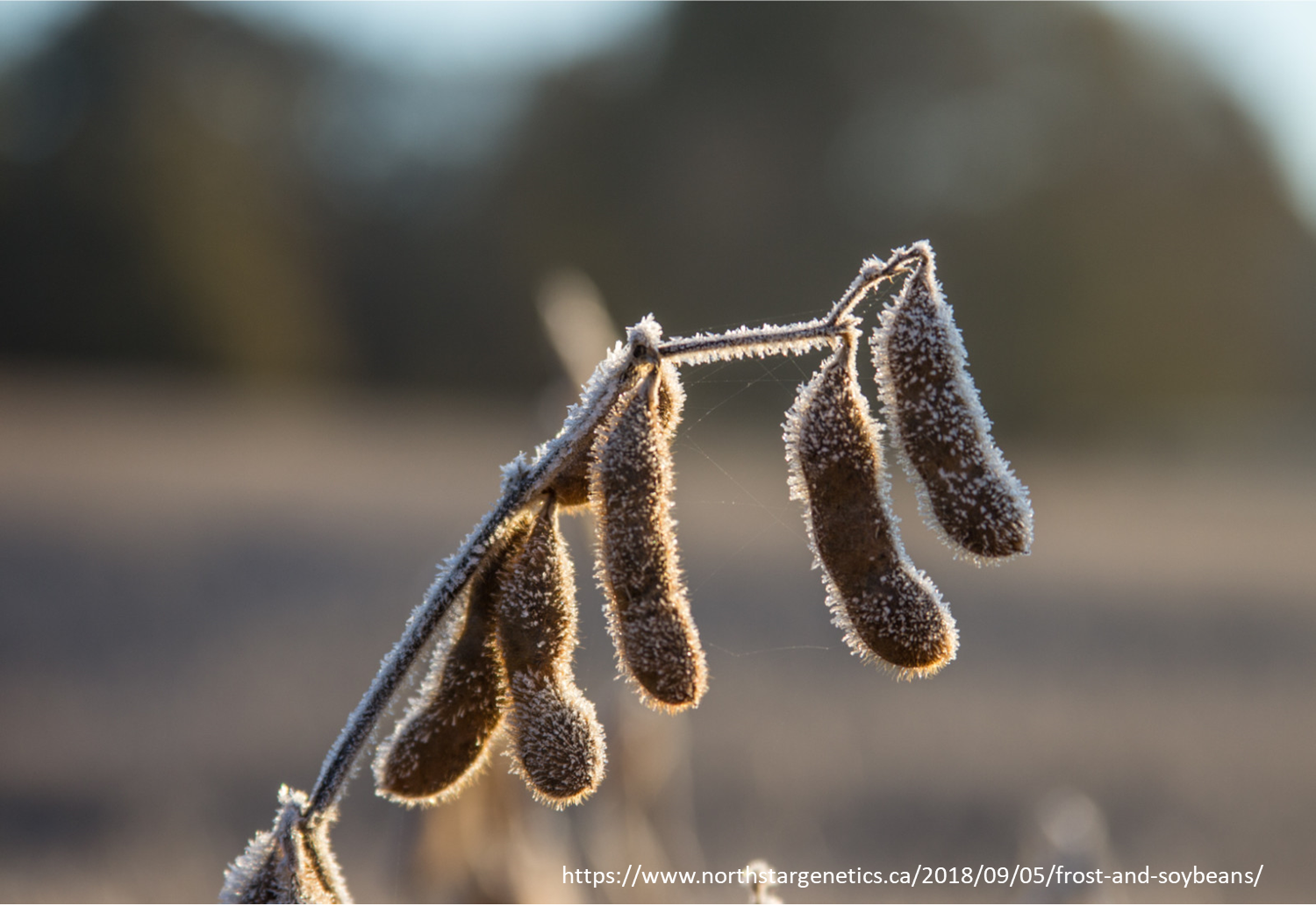
As harvest comes to a close, there is one event we all dread: overnight frost. In this week’s edition of Growing Possibilities, we are going to look at how early fall frost can affect various crops and its impact on the soil microbes.
Of the various crops grown in Canadian prairies, canola and soybeans are quite sensitive to frost damage. In the case of canola, if it’s nearing maturity and has moisture content below 20% then there will be minimal damage to the pods and seeds. However, if the moisture content is above 20% and the frost is heavy, then immature pods will initially turn dark green and the seeds will look translucent. In time, the pods will turn black and the seeds will shrivel up. Similarly, if the soybeans are near maturity (R7 or R8) then the pods will not be affected. Otherwise, frost will cause the upper leaves to wilt and the small upper pods will either have smaller seeds or abort. Regardless of the crop, if you do have overnight frost on your field, it is recommended that you wait 3-4 days before examining the field for frost damage (1).
There are numerous factors that can influence the frost severity. First is duration; the longer the crops are exposed to temperatures below 0°C, the more damage the plants will take. Second is the soil moisture; moisture retains heat so if the moisture content of the soil is high then there will be less damage to the crops. Also, canopy thickness is important; narrow rows with denser canopies will retain heat and lessen the damage to the crops. Next is wind speed; the stronger the winds the less damage the lower temperatures will cause. Lastly is cloud cover; more nighttime cloud coverage will reduce damage, whereas no cloud cover will increase the damage to the crop (2).
Now that we have covered the crops, how does frost affect the soil microbes? During overnight frost, the more sensitive microbes die and their nutrients are released into the surrounding soil. This temporarily increases the amount of nutrients in the soil, which helps the surviving microbes. Unfortunately, the released nutrients are easily washed away during rainfall or during snow melting. If multiple frost events occur, even more microbes will die, including nitrogen (N) fixing rhizobia and phosphorous (P) solubilizing bacteria. Also, those that do survive will not be as healthy and may not perform as efficiently (3). Therefore, we recommend applying inoculants every year to your seeds and in-furrow to ensure large, healthy populations of N-fixing rhizobia and P-solubilizing bacteria.
References
- https://www.manitobapulse.ca/2019/03/impact-of-fall-frost-on-soybeans/
- https://www.farmersedge.ca/facing-fall-frost/
- https://www.frontiersin.org/articles/10.3389/fmicb.2020.01164/full