

As the snow begins to accumulate on the fields and Christmas celebrations draw near, farmers are tinkering in their shops and dusting off their machinery. Even with the drier conditions this year, many of you are thinking of planting legumes next year. As most legume growers know, inoculating your legumes is essential for nitrogen (N) fixation and a great crop. But what is the difference between a good inoculant and a great inoculant? In this week’s edition of Growing Possibilities, we will be taking a look under the microscope and discussing what AGPT® is and why it is important in an inoculant.
As you may be well aware of, soil is extremely complex and heterogeneous. Most of us know there are different levels of various things, such as macronutrients, micronutrients, organic matter, pH, salinity, etc. But do you know about the various organisms that live in the soil? There are billions of organisms in a single spoonful of soil. Some are large enough to see with the naked eye, like earthworms, insects, and nematodes. But there is much more that are only visible under the microscope. Those organisms include bacteria, fungi, actinomycetes, protozoa, and algae. These organisms or microorganisms have been in the soil for millions of years, and the composition is different in every environment. For example, certain bacteria prefer hot and moist conditions like tropical jungles, whereas others thrive in the cooler and drier prairie. Therefore, each environment has a soil composition dominated by certain microorganisms than others (1). All of these microorganisms interact with the plants in that environment, which can be beneficial or antagonistic. Nitrogen-fixing bacteria (like Rhizobium) are an example of beneficial microorganisms for legumes. These bacteria reside naturally in the soil where the legumes grow naturally. Due to advancements in growing practices, legumes like soybeans are now being grown in places they couldn’t before. In those areas, there are no N-fixing bacteria to help the plants and inoculants are required (2).
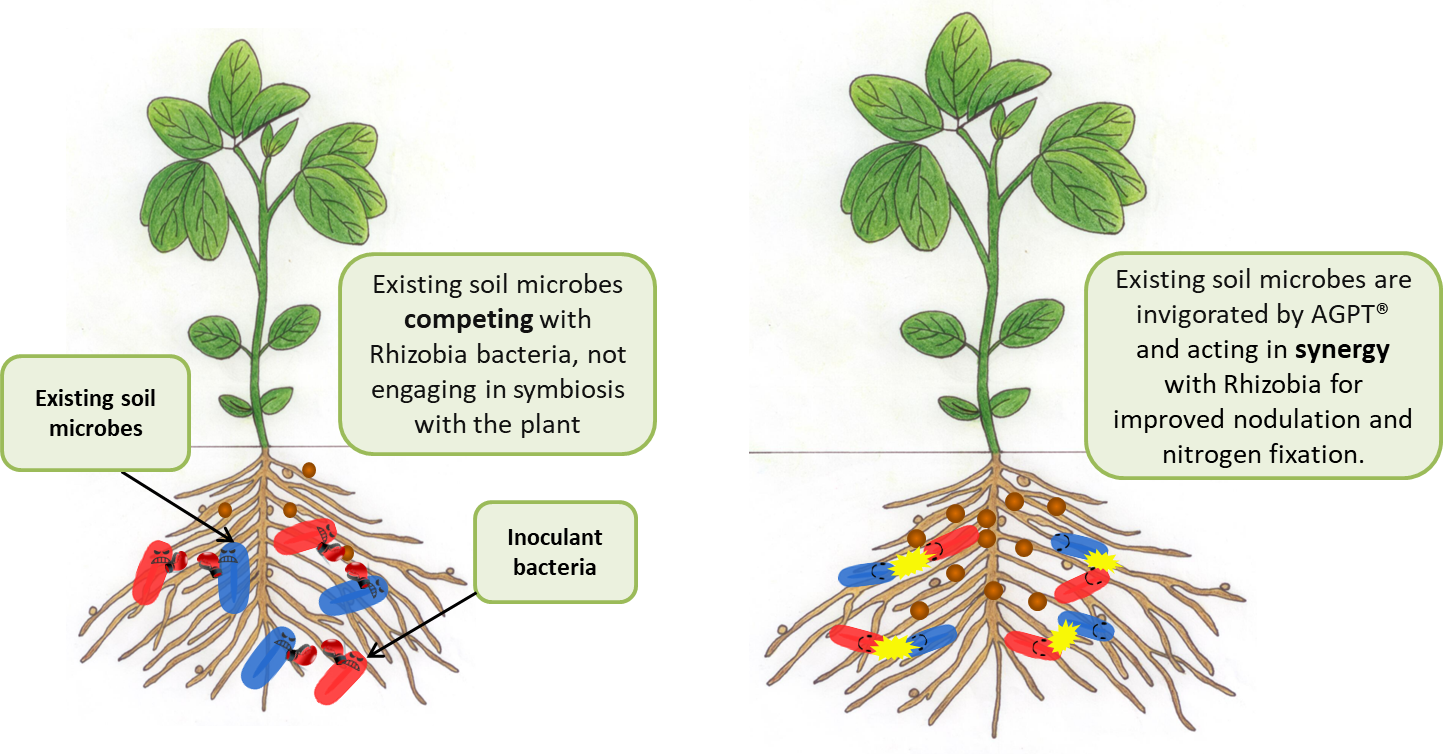
When it comes to inoculants, there are many variations you can find between products. One of the main differences between brands and products is the colony forming unit (CFU)/ml or g, aka, the actual number of bacteria within the product. An inoculant that boasts a higher CFU/ml will have more bacterial colonies in it, and therefore provide more bacteria to your soil. So the question comes to mind: the more the merrier? The simple answer is no. More bacterial colonies per unit of product isn’t always beneficial, and can often be harmful to your crop’s ability for N-fixation. For every crop there are an optimum number of N-fixing bacteria required in the surrounding root soil that will lead to maximum nodulation. Going beyond this number can lead to the bacteria introduced by your inoculant competing with the native soil microbes for resources such as space on your seed surface or nutrient resources or substrates. Life in the soil is incredibly competitive, and if your bacteria have to spend time and energy competing with each other then they are not colonizing or infecting roots and forming active nodules (2).
That’s where Advanced Growth Promoting Technology (AGPT®) comes in. AGPT® harnesses the plant growth promoting properties of natural soil bacteria and places it in easy to use inoculants for pulses and soybeans. These inoculants stimulate the native soil microbes to work together with the inoculant bacteria, creating more opportunities for nodule formation, higher N fixation, and improved yields. AGPT® inoculants are also formulated with the optimum number of N-fixing bacteria in your soil to ensure there is limited competition for nutrients and space in the soil with the native microbes (3). Both of XiteBio’s inoculant products use XiteBio’s proprietary AGPT® formulation, and that’s why we advocate using XiteBio® SoyRhizo® (for soybeans) and XiteBio® PulseRhizo® (for peas, lentils, and faba beans).
References
- https://www.producer.com/crops/new-biological-agent-a-first-in-canada/
- https://www.frontiersin.org/articles/10.3389/fpls.2020.00006/full
- http://www.seedquest.org/solutions.php?type=solution&id_article=35547&id_region=&id_category=&id_crop=