

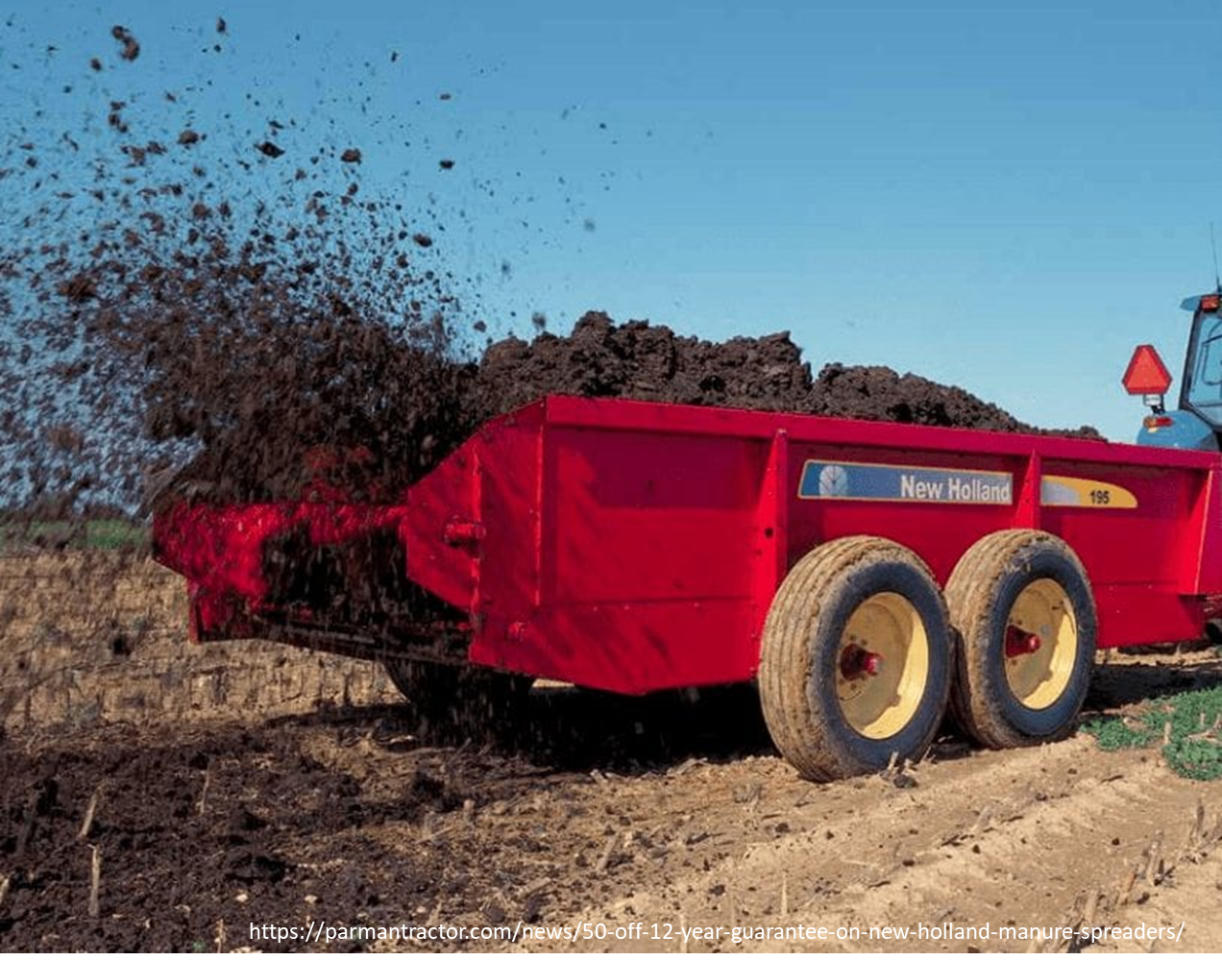
As the harvest season comes to a close and the weather begins to cool, many of you may be thinking of applying manure to your harvested fields. But you may be wondering is manure really beneficial to the soil microorganisms? In this week’s edition of Growing Possibilities, we will be looking into how application of manure affects the soil microbiology in general.
Manure is an excellent source of nutrients, of which approximately 80% of the manure solids will be used as food for the soil microbes (1). This increase in nutrients will feed the microbes and allow them to replicate and increase in numbers. The increase in microbe numbers means there are more microbes available for nutrient cycling of nitrogen (N), phosphorus (P) and carbon (C) (2). Depending on the manure composition, the time required for the C in the manure to decompose via the microbes can be quite different. If the manure is from a forage based diet, then it will contain more cellulose and lignin, which will take longer to decompose since they are more difficult to break down. Whereas, if the manure is from a corn based diet, it will take less time to decompose since the sugars in corn are less complex and easier for the microbes to break down (1).
In order for the microbes to break down the C in the manure, they need a certain amount of N. If there isn’t enough N in the manure, then the microbes will take the N required from the soil and will deplete the N in the soil, while increasing its C content. If there is plenty of N in the manure, then the microbes will use it to break down the C in the manure. For example, if you added a high C manure like swine manure to a field that has a high C:N ratio (proportion of organic C to total N), the microbes will take the N out of the soil in order to break down the large volumes of C and thus will cause further depletion of N in the soil (2).
But how is this beneficial to microbes? Having a large food supply allows the microbe numbers to increase and allows a larger diversity of microbes to grow. A larger diversity of microbes creates a more stable microbial community, which helps maintain the sustainability of that ecosystem by making the microbes stronger and more resilient to stress. This, in turn, helps improve the living conditions of the natural microbial community by increasing access to nutrients from various sources and making the microbial community more resilient to environmental change (3). Hence, manure is in general beneficial to soil microbes but how it affects the succeeding crop you are planting depends on the source of the manures it is coming from.
References
1). http://www.omafra.gov.on.ca/english/crops/field/news/croptalk/2015/ct-0615a1.htm
2). https://www.canr.msu.edu/uploads/files/AABI/Manure%20effects%20on%20soil%20organisms.pdf
3). https://www.ncbi.nlm.nih.gov/pmc/articles/PMC4193766/