

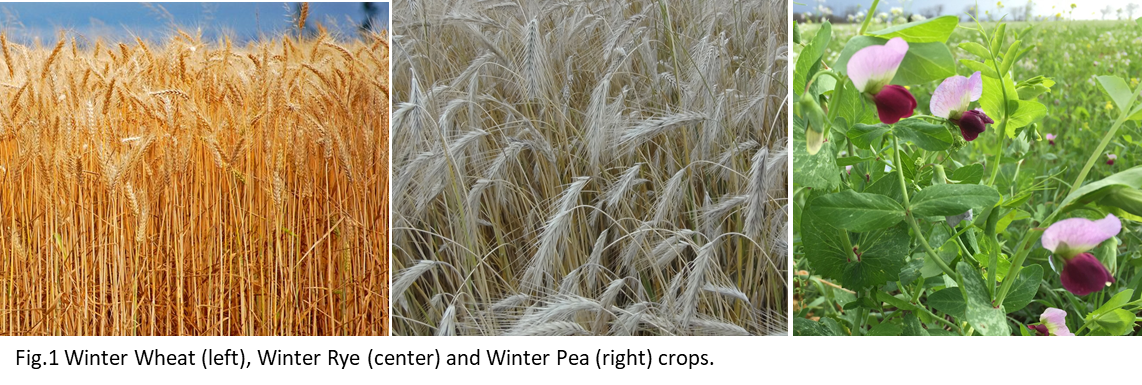
In the last several years many growers have begun growing a fall seeded crop on their acres over winter. These winter crops are growing in popularity, and don’t seem to be a fly by night trend. If you are considering a crop like this, what do you need to know before you rush to get planting? In this week’s edition of growing possibilities, we will be looking at winter crops, the benefits they offer, and what you need to know about planting them this fall.
There are several types of winter crops you could grow, but winter cereals like winter wheat and rye and winter legumes like winter peas and lentils are the most popular. Winter legume varieties are becoming popular on the prairies, not just as a cover crop but as a cash crop as well. In southern Alberta, winter pea and lentil crops have yielded up to 39 percent more than spring varieties (1). Winter cereals are growing in acreage across Canada and the United States, which signals the growing popularity of these crops. 1.5 million acres of winter wheat was seeded in Canada in the fall of 2020, and 592,000 acres of fall rye are expected to be seeded in 2021 (2). The USA saw even more winter cereal acres seeded in 2020, with 30.4 million acres of winter wheat planted, 2 million acres of rye was also seeded in 2020, including fall planted rye (3).
Winter crops are more than just a cash crop though, offering numerous benefits to your field’s nutrition and sustainability. Winter cover crops can block wind and prevent soil erosion in your field, prevent moisture and nutrient loss underground, hold snowfall to provide more moisture come spring, and interrupt weed/pest cycles just to name a few (4). Fall-seeded legumes also contribute to nitrogen (N) nutrition in your soil through N-fixation. Winter legumes fix N in both the autumn and the following spring, totalling a period of 12-16 weeks (4). This period of N-fixation lasts longer than that of a spring crop, and in the case of winter peas can add 90-150 lbs/acre of N back into the soil (5). In a study of winter pea, rates of 180 lb N/Acre of fertilizer did not outperform fields with pea residues when growing barley (4).
Seeding for winter crops is usually comparable to their spring counterparts, with field conditions being the major difference. It is recommended that you seed into stubble of a previous crop, as this will help to protect the roots of your plants from soil heaving from freezing and thawing, and by trapping snow. Snow trapped by field stubble provides insulation for young winter crops and keeps them from being subjected to the coldest of winter temperatures.
Crop inputs are an important consideration for any crop, winter crops being no exception. Fall-seeded legumes form symbiotic relationships with soil bacteria to fix N from the air just like spring varieties, so if you are planting a legume crop this fall, a rhizobial inoculant is recommended to guarantee nodulation and maximize N fixation. Just be sure that your inoculant of choice can be used on winter legume varieties (such as XiteBio® PulseRhizo®) as not all inoculants are approved for such use.
Phosphorous (P) is essential to producing a healthy, high-yield winter wheat crop, with winter cereals having a higher P demand than spring varieties (4). P resources are essential to early plant development, and establishing plant stands before the winter freeze sets in is essential. Plants entering freezing soil conditions with 6-8 inches of stand have been shown to have the best survivability over winter (6). Ensuring your crop’s P nutrition means more than just applying fertilizers though. P fertilizers have an average efficiency of less than 50% (7), meaning more than half of the applied fertilizer will become bound in soil particles which are not available for plants’ uptake. During the overwinter growing season this is a larger concern, as cold temperatures increase the amount of phosphates bound in soil. These circumstances can make getting P a tough job for your plants. Including a P-solubilizing biological like XiteBio® Yield+ in your crop input plan can liberate these locked-up phosphates and make them available to plants, increasing your fertilizer’s efficiency and decreasing the strain on your wallet.
Winter crops are more than a trend, and are leaving permanent waves across North American agriculture. Planting a winter crop can turn an empty field into one little victory for proactive growers, so you may want to consider one after this year’s harvest has come to a close.
References:
1) https://www.producer.com/news/feel-your-pulse-next-winter-it-might-be-rising/
2) Statistics Canada. Table 32-10-0359-01 Estimated areas, yield, production, average farm price and total farm value of principal field crops, in metric and imperial units
3) https://www.nass.usda.gov/Publications/Todays_Reports/reports/wtrc0121.pdf
4) McGee, R.J., Eigenbrode, S., Nelson , H., Schillinger, W. (2017). Re‐inventing Austrian winter pea towards developing food quality winter peas. Crops & Soils, 50(4). https://doi.org/10.2134/cs2017.50.0401)
5) Clark, Andy. Managing Cover Crops Profitably (3rd ed.). 2008. Beltsville, MD: Sustainable Agriculture Network. P. 135- 141.
6) https://www.covercrop.com/?p=214
7) The Efficient Use of Phosphorus in Agricultural Soils, The Fertilizer Association of Ireland in association with Teagasc, Technical Bulletin Series – No. 4, February 2019