

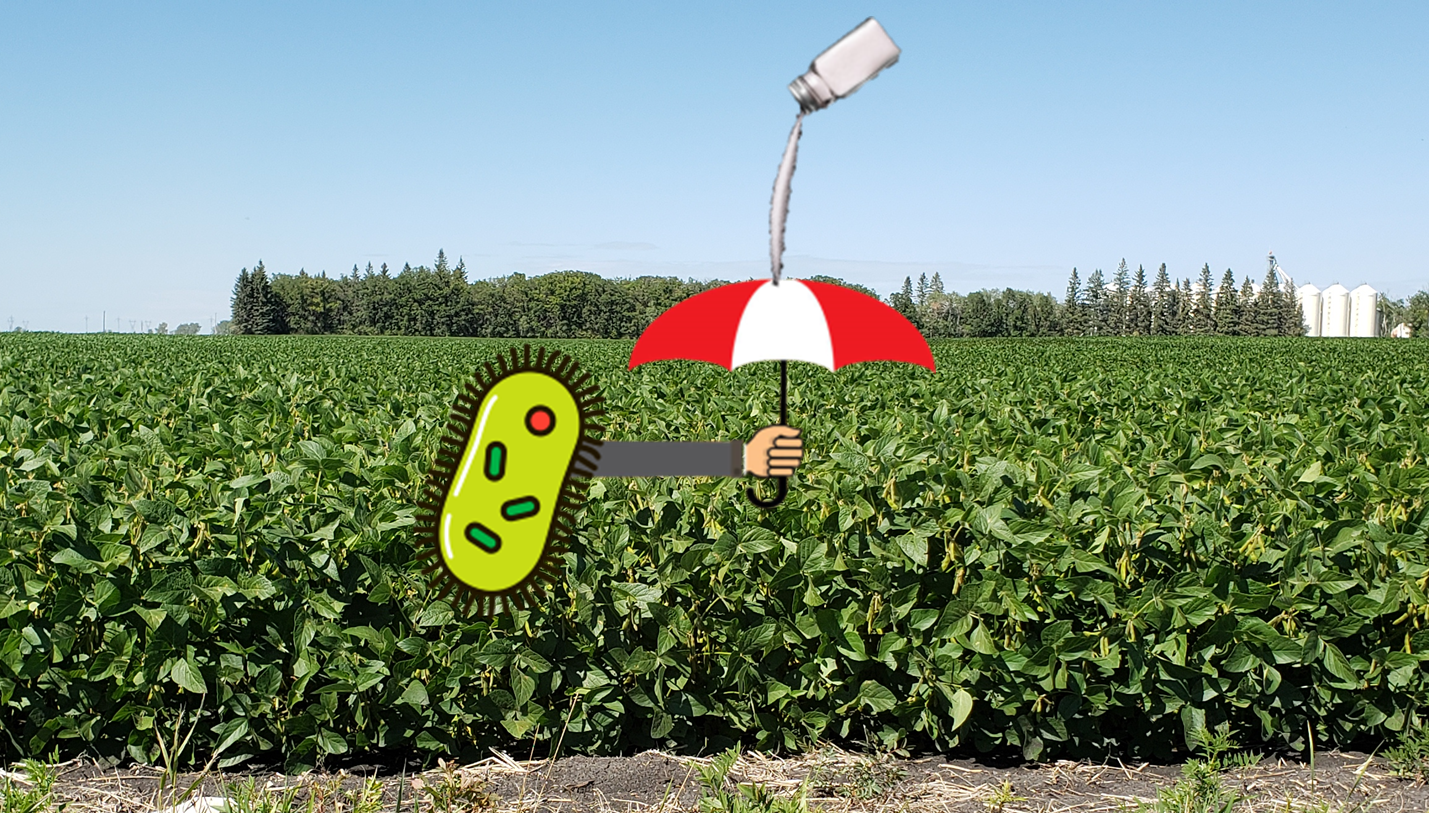
In the past we have covered several different ways in which Plant Growth Promoting Rhizobacteria (PGPR) can help growers and their crops. A healthy rhizosphere with microbial activity can improve not only your plant health but your soil health as well. In this week’s edition of Growing Possibilities blog, we will try to address how PGPR may be able to help growers with yet another common problem in the field: salinity and salt stress.
Soil salinity is one of the most common abiotic stressors affecting plants and fields in arid/semiarid regions. More than 20% of the globes irrigated land is affected by salinity stress (1) and it is estimated that by 2050, the growth potential of 50% of the planets arable land will be negatively affected by salinity (2). Salt stress affects almost all aspects of plant growth, including nutrient uptake, photosynthesis and development of root and shoot tissues. Under salt stress conditions, the capacity for water absorbance decreases and the transpiration rate of water increases, where more water is lost by plants than is taken up. Salt stress also causes the release of ethylene, a plant hormone that inhibits hypocotyl and root elongation and rushes a plant into earlier maturity in an attempt to deal with this environmental stress (1).
Many species of soil bacteria also dislike an excessively saline environment and have evolved mechanisms to help them deal with the stress of a saline environment. In the cases of soil bacteria living in a plant rhizosphere, they may be able to pass some of the benefits of these adaptations on to their plant hosts. Here are some ways in which PGPR have been shown to assist plants during salt stress:
- Phytohormone production: PGPR that produce phytohormones can encourage earlier and more robust root development, enabling plants to uptake both more nutrients and more water from the soil. One study on soybeans found that PGPR species releasing phytohormones like IAA greatly improved emergence, shoot and root development when compared to control plants in a saline environment (3).
- Nutrient Availability: PGPR bacteria that solubilise soil-bound nutrients (like Phosphorous) and make them more available to plants can help to reduce the negative effects caused by salt stress. PGPR that solubilize phosphorous (P), one of the most essential nutrients for early plant development, can create plant available forms of P from sources in the soil otherwise inaccessible to plants.
- Extracellular Polysaccharides (EPS): When under stress, many bacteria species produce a slimy substance called EPS to protect them from environmental hazards like desiccation and salinity. If PGPR species inhabiting plant rhizospheres begin to release these EPS, the substance may also coat the roots of their host plant, forming a protective layer around them that can bind salt ions and prevent them from reaching the plant. Species of Bacillus PGPR have been shown to alleviate salt stress through this method in wheat (4), mungbean (5) and soybean (3) in separate studies.
- Ethylene Deactivation: Some PGPR species can produce an enzyme that breaks down the building blocks of the hormone ethylene (called ACC deaminase), preventing it from being produced by plants. This reduces ethylene levels in the surrounding environment, which stops plants from limiting their growth due to salt stress (6).
Soil microbes like PGPR are quickly showing themselves to be a viable method for improving plant response to salt stress in a sustainable and field-friendly way. Soil bacteria have a number of plant health boosting mechanisms under their belt already, and if this research continues to show promising results then you may see it reflected in the products on the shelf in the not too distant future.
References:
1) Riyazuddin R, Verma R, Singh K, Nisha N, Keisham M, Bhati KK, Kim ST, Gupta R. Ethylene: A Master Regulator of Salinity Stress Tolerance in Plants. Biomolecules. 2020; 10(6):959. https://doi.org/10.3390/biom10060959
2) Dorothea Bartels & Ramanjulu Sunkar (2005) Drought and Salt Tolerance in Plants, Critical Reviews in Plant Sciences, 24:1, 23-58, DOI: 10.1080/07352680590910410
3) Kasotia, A., Shekhar, J., Vaishnav, A., Kumari, S., Guar, RK., Choudhary, DK. Soybean Growth-promotion by Pseudomonas sp. Strain VS1 under Salt Stress. Pakistan Journal of Biological Sciences 2012, 15 (14):698-701.
4) Amna, Bashir Ud Din, Sidra Sarfraz, Ye Xia, Muhammad Aqeel Kamran, Muhammad Tariq Javed, Tariq Sultan, Muhammad Farooq Hussain Munis, Hassan Javed Chaudhary, Mechanistic elucidation of germination potential and growth of wheat inoculated with exopolysaccharide and ACC- deaminase producing Bacillus strains under induced salinity stress. 2019. Ecotoxicology and Environmental Safety, Volume 183, https://doi.org/10.1016/j.ecoenv.2019.109466.
5) Mahmood S,DaurI, Al-Solaimani SG, Ahmad S, Madkour MH, Yasir M, Hirt H, Ali S and Ali Z(2016) Plant Growth Promoting Rhizobacteria and Silicon Synergistically Enhance Salinity Tolerance of Mung Bean. Front. PlantSci.7:876. doi: 10.3389/fpls.2016.00876
6) Khan, M.A., Asaf, S., Khan, A.L. et al. Alleviation of salt stress response in soybean plants with the endophytic bacterial isolate Curtobacterium sp. SAK1. Ann Microbiol 69, 797–808 (2019). https://doi.org/10.1007/s13213-019-01470-x