

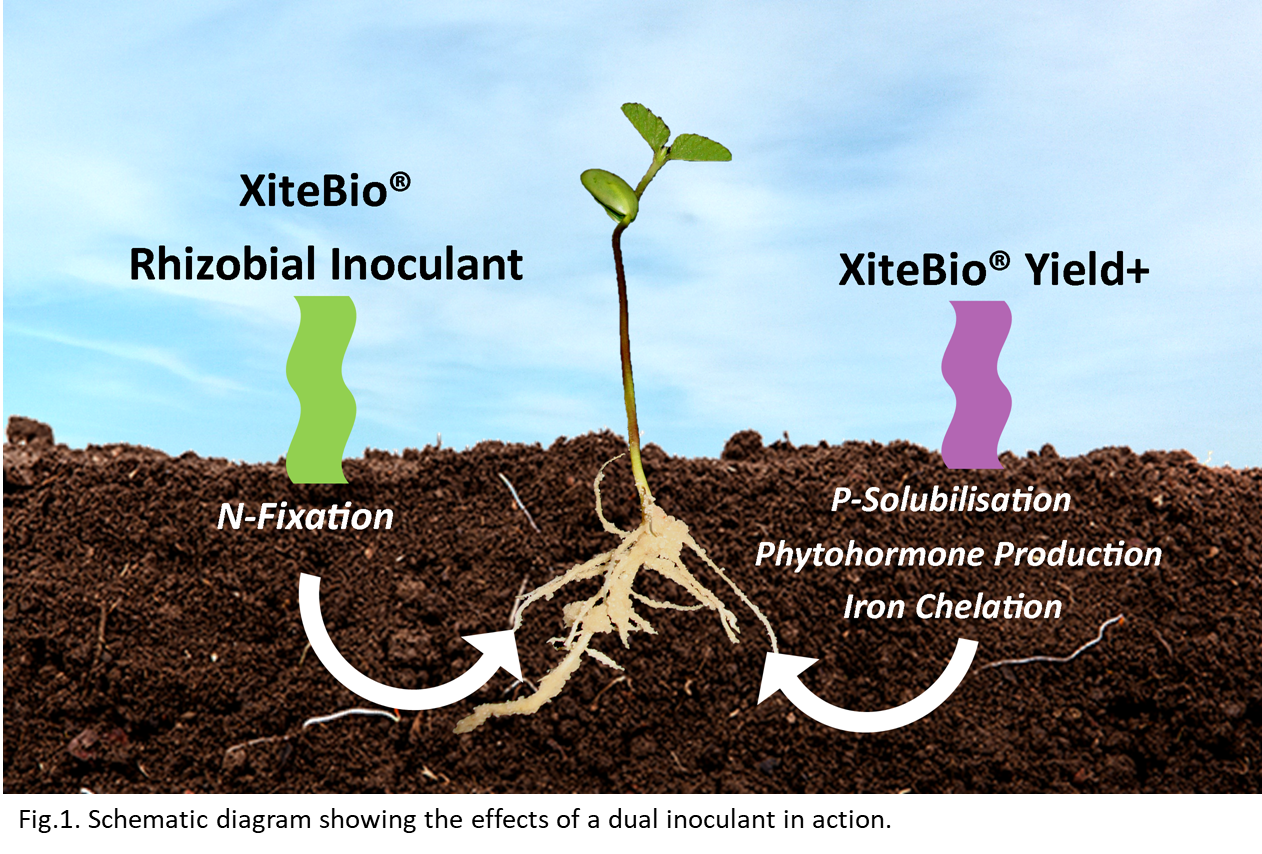
Rhizobial inoculants are nothing new to legume growers, to whom inoculation with nitrogen (N) fixing bacteria is a yearly endeavour. A lot of these same growers may also be familiar with other forms of Plant Growth Promoting Rhizobacteria (PGPR), which offer benefits like phosphorus (P) solubilisation, sulphur (S) oxidation, iron (Fe) chelation, phytohormone production, etc. What these growers may not know, however, is the benefits gained by utilising both of these technologies on your crop at the same time. In this week’s blog, we will look at why applying both N-fixing bacteria as well as other forms of PGPR can give your legume crop the boost in plant health and growth promotion it needs to reach its peak this season.
Inoculating your legumes with N-fixing rhizobia will get your crop most of its N requirement, but N isn’t the only thing that lends itself to a healthy, high-yielding crop. Legumes have a large requirement for P, and studies have shown that inoculating your legumes with both P-solubilising bacteria and N-fixing bacteria can boost your plant’s P nutrition and result in higher yields & dry weights (1). PGPR doesn’t just help with P though, the release of phytohormones and iron-chelating siderophores have been shown to offer even better benefits to your crop. Enhanced root development early in the growing season is a huge benefit that phytohormones bring to the table, increasing uptake of plant available nutrients, air and water. In one study, the addition of PGPR with these modes of action to the crop input plan resulted in a higher number of nodules, higher root and shoot weights when compared to plants inoculated with N-fixing rhizobia alone (2).
Protein content is quickly becoming one of the most important factors soybean and pulse farmers look for in their crop. Higher protein content and higher protein quality, has a drastic effect on the market value of soybeans, and with interest in plant derived protein sources growing across North America this value is quickly increasing. Inoculating your legumes with a PGPR biological as well as a traditional inoculant has been shown to have an effect on the protein content of legume seeds in addition to previously mentioned growth benefits. A soybean study found protein concentrations to be between 5-8% higher in plants treated with N-fixing rhizobia and an additional PGPR strain (3). Another soybean study found the use of a Bacillus species of PGPR (like the one found in XiteBio® Yield+) in conjunction with a traditional inoculant yielded a 9.2% increase in oil content and a 9.6% increase in protein concentration in harvested seeds when compared to a control (4).
These protein yield benefits extend beyond soybeans too. A study on field peas noted that inoculating with both an N-fixing rhizobial inoculant and another PGPR strain resulted in better seed filling, higher seed mass and higher N uptake (5).
It is clear that adding a PGPR biological to your crop input plan in addition to a rhizobial inoculant can have dramatic effects on your legume crops. XiteBio’s PGPR biological, XiteBio® Yield+, offers 3 modes of action (P-solubilisation, Phytohormone production, Iron chelation) to benefit your crop all season long, and combining it with XiteBio’s AGPT powered rhizobial inoculants (XiteBio® SoyRhizo® for soybeans or XiteBio® PulseRhizo® for peas, lentils and faba beans) can create a team of soil bacteria ready to see your crop succeed to its highest level.
Combining these two technologies just got easier for soybean growers in 2021 with XiteBio® OptiPlus® Dual Inoculant for soybeans. Available in a limited trial run for the 2021 growing season, XiteBio® OptiPlus® is XiteBio’s N-fixing AGPT technology and our unique Bacillus based PGPR all together in one package. XiteBio® OptiPlus® is for in-furrow application only. Please see our website for application rates and tank-mix compatibility with other products.
References:
1) Yadegari, M., Rahmani, HA. Evaluation of bean (Phaseolus vulgaris) seeds inoculation with Rhizobium phaseoli and plant growth promoting rhizobacteria (PGPR) on yield and yield components. 2010. African Journal of Agricultural Research, Vol. 5 (9).
2) Egamberdieva, D., Jabborova, D., Berg, G. Synergistic interactions between Bradyrhizobium japonicum and the endophyte Stenotrophomonas rhizophila and their effects on growth, and nodulation of soybean under salt stress. 2015. Plant Soil (2016) 405: 35-45.
3) Dashti, N., Zhang, F., Hynes, R., Smith, D.L. Application of Plant Growth-Promoting Rhizobacteria to Soybean (Glycine max[ L .] Merr.) Increases Protein and Dry Matter Yield under Short-Season Conditions. 1997. 33–41.
4) Mondani, F., Khani, K., Honarmand, S.J., Saeidi, M. Evaluating effects of plant growth-promoting rhizobacteria on the radiation use efficiency and yield of soybean (Glycine max) under water deficit stress condition. 2019. Agricultural Water Management, Vol: 213: 707-713.
5) Ranjbar, Sistani N., Kaul, H-P., Desalegn, G., Wienkoop, S. Rhizobium Impacts on Seed Productivity, Quality, and Protection of Pisum sativum upon Disease Stress Caused by Didymella pinodes: Phenotypic, Proteomic, and Metabolomic Traits. 2017. Front. Plant Sci. 8:1961.