

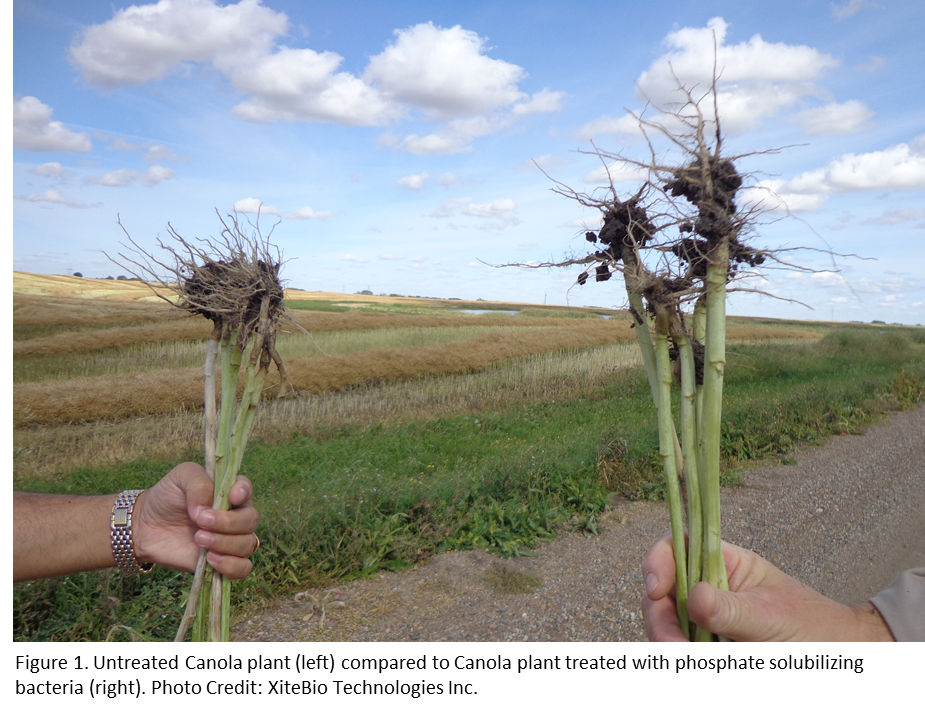
All growers know the importance of phosphate fertilizer and ensuring adequate phosphorous (P) sources in your soil, but what some growers may not know is just how important P is to your crop right from seeding. P nutrition is critical to early plant development, so in this week’s edition of Growing Possibilities, we will be discussing the integral effects of early P nutrition on your crop and how to make sure your plants have enough right from the get go.
Phosphate fertilizers are the tried and true way to put more P into your soil, and when it comes to improving your plants health, the earlier the better. Phosphate fertilizer applied at or around seeding performs better than fertilizer applied later in the season and shows the necessity of early P to a successful crop. For example, phosphorus supply during the first two to six weeks of canola growth is critical to achieving the highest yields possible. Abundant plant available P in the soil can lead to earlier plant emergence, better early plant growth, and earlier plant maturity (1).
The importance of early access to soil P by plants is also evident in the effects of a lack of P during early development. Limiting P later in the season had a much smaller impact on yield when compared to limitations during the first several weeks of plant development. Phosphorous plays a large part in early root development, meaning a lack of P early on can lead to difficulty with the uptake of other nutrients and with plant growth in general (2).
Phosphate fertilizer applied close to seeding provides more benefits than later applied P, but it is not without its drawbacks. The seedlings of some row crops, such as canola and pulse crops, are sensitive to seed-placed phosphate. Too much phosphate placed with the seed can negatively affect germination and emergence with these crops, reducing the plant stands and undoing your hard work during application. For peas, faba beans, and canola a maximum of 20 lbs/ac of seed-applied P2O5 is recommended to prevent damage to your plants. For dry beans and soybeans, this number is even lower at 10 lbs/ac (3). Cold soil also decreases the efficiency of your applied P fertilizer efficiency, speeding up the rate at which soil phosphates become bound by other soil particles, becoming unavailable for plant uptake (1).
These limitations mean P fertilizer alone is not enough to ensure your crops’ early season P nutrition, so what are your other options for getting P to your plants as soon as possible?
Phosphate solubilizing bacteria, like the Bacillus species found in XiteBio® Yield+, are a good complement to your plant fertility program that can increase your plants’ access to soil phosphates early in the season without causing damage. Phosphate solubilizers break the bonds between phosphates in the soil and soil particles that bind to them and lock them up, creating plant-available forms of phosphate. XiteBio® Yield+ not only solubilizes phosphates from your applied fertilizers, increases their efficiency, it also solubilizes the fixed phosphates from the natural phosphate reserves present in the soil. Phosphate solubilizing bacteria like XiteBio® Yield+ can increase your fertilizer use efficiency, make available some of the unavailable soil fixed phosphates, and can be applied in the seed furrow along with compatible starter fertilizers. To learn more about how XiteBio® Yield+ can enhance your phosphate management program, Click Here.
References:
1) https://www.canolacouncil.org/canola-encyclopedia/fertility/phosphorus/
2) Grant, C.A., Flaten, D.N., Tomasiewicz, D.J., Sheppard, S.C. 2001. Importance of Early Season Phosphorus Nutrition. Better Crops, 85 (2).
3) https://www.gov.mb.ca/agriculture/crops/soil-fertility/soil-fertility-guide/phosphorus.html