

As sure as the sun rises every morning, farmers will apply phosphorous (P) to their fields every year. Either before or during seeding or even during the season for a P boost, all growers should be familiar with phosphate fertilizers and their importance to a healthy, high-yielding crop. But fertilizer is much more complicated than just applying it to your fields. Issues like soil binding and aggregation in cold soil particles can have significant effects on your field’s P status and the fertilizer you apply. In this week’s edition of Growing Possibilities, we will be explaining how your P fertilizer is affected after application, and how you can make the most of your fertilizer investment this season.
Phosphorous is essential to plants throughout the growing season, and is especially important during early development. Good P nutrition can lead to earlier plant emergence, better early plant growth and earlier plant maturity (1). Phosphorous plays a large part in early root development, so adequate P early on will encourage a better root system which helps in the uptake of all nutrients and general plant health boosts (2). Phosphorous can be added to your soil in a variety of ways, with one of the most common methods used by growers being inorganic phosphate fertilizers. Inorganic fertilizers are created from rock phosphates that is mined and turned into the common end products most growers are familiar with. These include dry products such as Monoammonium Phosphate (MAP) and Diammonium Phosphate (DAP), as well as liquid products such as superphosphoric acid, which is commonly mixed with nitrogen and/or potassium sources to create combination products such as 10-34-0 and other NPK fertilizers (3).
There is more to adding P to your soil then just applying fertilizers though. Applied P fertilizers have a low efficiency in the soil after application, which means on average less than 50% of the P that is applied to soil remains available for plants to uptake (4). The reason for this low plant availability is binding by soil particles. Some mineral ions in soil will bind to P as they encounter it and convert it into forms that are unavailable to plants, reducing the P from your fertilizer that actually makes it into your crop. For starter fertilizers applied in the spring this is an even larger concern, as soil-phosphate binding increases in cold soil, further diminishing plant-available phosphate reserves. The main sources of P binding in soil are:
- Calcium (Ca), which forms the compound Ca3(PO4)2
- Iron (Fe), which forms the compound FePO4
- Aluminum (Al), which form the compound AlPO4
These minerals are important nutrients for plant health themselves, so removing them to combat P binding is not a feasible option. So how can you further increase P available from your fertilizers to your crop without jeopardizing the plant health?
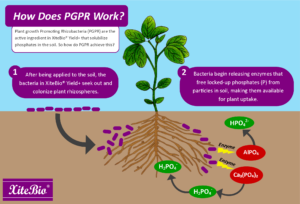
An eco-friendly and cost-effective way to improve the efficiency of your fertilizer applications is the use of P-solubilizing bacteria. P solubilizing bacteria, like the Bacillus species found in XiteBio® Yield+, break down the P-binding compounds mentioned earlier and liberate the phosphates from them, creating plant-available forms of P (H2PO4– or HPO42-) and increasing the reserve of P in the soil for your crop. This solubilization doesn’t just increase the P coming from your fertilizers either. P-solubilizing bacteria also free up other phosphates naturally present in the soil or leftover from previous fertilizer applications. These phosphates are called “legacy Soil P”, and making them plant-available allows growers to make the most of previous fertilizer investments and soil P already in their fields (5). XiteBio® Yield+ offers the benefits of P-solubilization as well as other modes of action, such as phytohormone production and iron chelation, and can be tank-mixed with compatible liquid fertilizers or applied early post with your first pass of herbicide application. To learn more about how XiteBio® Yield+ can fit into your crop fertility plan this season, Click Here.
References:
1) https://www.canolacouncil.org/canola-encyclopedia/fertility/phosphorus/
2) Grant, C.A., Flaten, D.N., Tomasiewicz, D.J., Sheppard, S.C. 2001. Importance of Early Season Phosphorus Nutrition. Better Crops, 85 (2).
4) The Efficient Use of Phosphorus in Agricultural Soils, The Fertilizer Association of Ireland in association with Teagasc, Technical Bulletin Series – No. 4, February 2019
5) Rowe, H., Withers, P.J.A., Baas, P. et al. Integrating legacy soil phosphorus into sustainable nutrient management strategies for future food, bioenergy and water security. Nutr Cycl Agroecosyst 104, 393–412 (2016). https://doi.org/10.1007/s10705-015-9726-1