

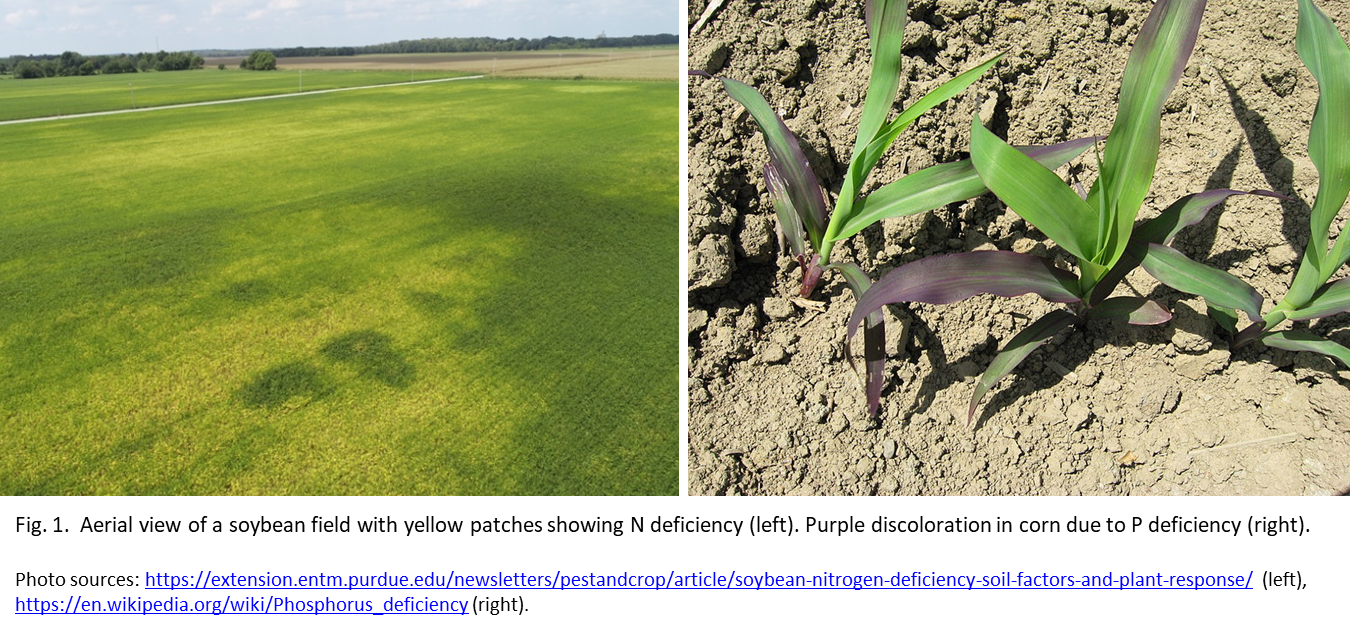
Two of the most essential nutrients to growing any row crop are nitrogen (N) and Phosphorous (P). Growers spend a lot of time and money every season fertilizing their fields with N and P, but how do they know when their plants are getting enough? And if your plants are deficient in either of these nutrients, how can you tell? In this week’s edition of growing possibilities, we are going to look at how deficiencies in these key nutrients cause harm to your crop, and what you can do to fix it.
All major row crops will remove some nutrients with harvest, either through the actual harvested portion of the crop or from leftover biomass, and replacing those nutrients is essential for next year’s crop getting off to a good start. This may seem obvious to most farmers, but what may not be obvious is just how much is removed during the season. The following table lists the typical uptake & removal rates for N and P for some common crops and should give you an idea of what to expect from your own crops.

Phosphates being locked up by metal ions in soil are another big culprit when it comes to losing plant-available soil P. Phosphates added to soil are rapidly bound by other soil particles, forming phosphate compounds which plants cannot access and use. This problem gets even worse in the beginning of spring, as phosphate binding is exacerbated by cold soil temperatures. Phosphates from applied fertilizers being locked up by these soil particles is a significant source of P loss, with more than 50% of the P you apply to soil becoming unavailable to plants shortly after application (1).
So what are the signs of N and P deficiency? Plants deficient in nitrogen will usually have pale yellow leaves and have slower, stunted growth (2). This discoloration will start at the lowest leaves of the plant first and slowly move up if deficiency persists. This yellowing of leaves due to N deficiency can be seen in corn, soybeans, canola, wheat, and other popular row crops and is the most noticeable symptom for diagnosis (2, 3). P deficiency is harder to spot during the growing season, with the only consistent visual indicator for all crops being slower, stunted growth (2). Soil testing before or after the season is the sure-fire way to diagnose a lack of these nutrients in your soil, providing accurate results you can’t get during the season.
So how can you make sure your crops get the N and P they need to reach their highest yields? Inoculating your legume crops with the correct species of N-fixing rhizobia can help it get almost all the N it will need directly from the air. Legume crops like peas, lentils and soybeans form symbiotic relationships with bacteria that will fix N for them, meaning they do not need to rely as heavily on N present in the soil. Soybeans can get up to 60% of their required N through N-fixation, while Peas, Lentils and Faba beans can get up to 80% (4). Ensure you are using the correct inoculant for the crop you are growing, as they are specific to each crop.
Growers replenish their soil P reserves every year with the addition of P fertilizers to the soil, but there is a way to enhance the efficiency of your fertilizer applications to get the most out of your soil. Phosphate-solubilising bacteria, like the Bacillus species found in XiteBio® Yield+, break the bonds between soil P and the particles that bind them. By liberating these soil phosphates, the bacteria create plant-available forms of P and increase the P reserves your crop can take from. This not only increases the efficiency of the P fertilizers you apply to the field, it also creates plant available forms of phosphate from P already in your soil. Incorporating a phosphate solubilizing bacteria such as XiteBio® Yield+ into your crop input plan would definitely complement the phosphate fertilizer you apply as it would increase the efficiency of the fertilizer used, potentially enhancing your bottom line ROI.
References:
1) The Efficient Use of Phosphorus in Agricultural Soils, The Fertilizer Association of Ireland in association with Teagasc, Technical Bulletin Series – No. 4, February 2019
2) Nutrient-Deficiencies-and-Application-Injuries-in-Field-Crops-Integrated-Pest-Management – John Sawyer
3) https://www.canolacouncil.org/canola-encyclopedia/fertility/phosphorus/
4) https://saskpulse.com/growing-pulses/